

Hello and welcome to this week’s edition of Safety Pro Weekly.
Most organizations say they care about safety. And they do, but many times they don’t know what it means to have an effective and robust safety program.
Sure, they have policies, procedures, training records. They may even have regular safety meetings. But somehow, they still aren’t getting the results that they want. No matter what new system or program they try, underneath the surface, something still isn’t working.
Most often the signs are there if you know where to look:
Supervisors nod in agreement but don’t follow through.
Toolbox talks feel flat, boring and repetitive.
JHSC meetings check the boxes but rarely spark real discussion.
Workers comply if they have to, but they’re going through the motions. The minute you walk away, it’s right back to the way they were doing things before.
And this gap between compliance and participation is the engagement problem no one talks about.
The Myth: If We Just Communicate More, Engagement Will Improve
Many safety professionals respond to low engagement by increasing communication. They respond by adding volume:
More reminders to workers and supervisors.
More emails to management.
More policies, (as if anyone read the last batch).
More training (that costs time and money and still doesn’t stick).
It’s as if they’re trying to ram as much information as possible down worker’s throats.
But communication volume does not equal ownership. You can (and probably have) tried to talk things through with workers and management until you’re blue in the face.
We’ve found out the hard way that it rarely works. Engagement isn’t created by pushing more information.
Engagement is created when people feel responsible for outcomes.
To do that, you need to make safety personally relevant to your audience. And the message has to be targeted for the group you’re trying to influence.
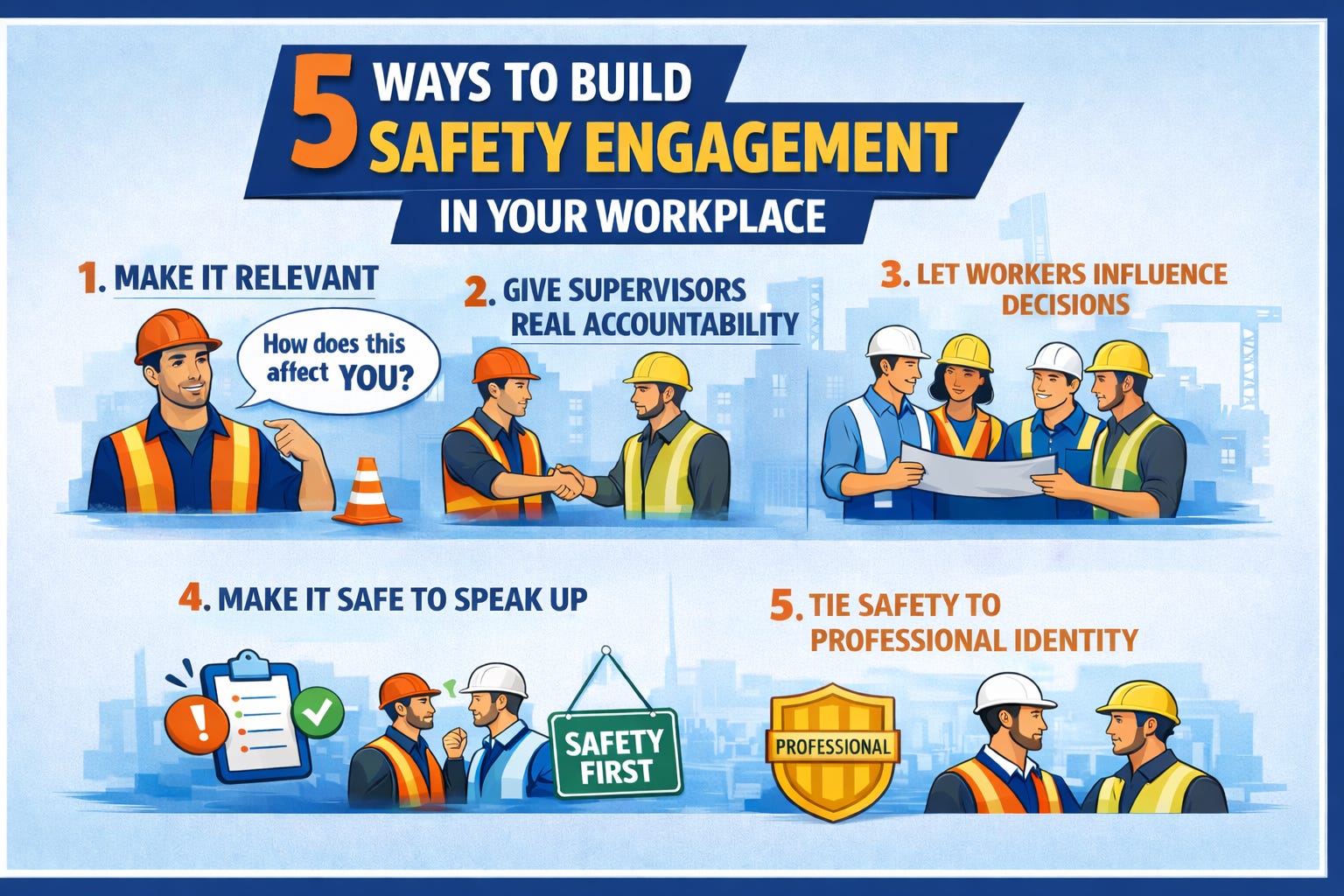
Here are 5 ways you can get people to buy in:
1. Make it Relevant
Most safety programs are communicated in an abstract way. You’ll hear a lot of discussion about things like:
Zero harm.
Target TRIR.
Corporate commitment (blah, blah, blah).
If your audience can’t understand what that means for them, whether workers, supervisors or senior management, the message doesn’t feel personal and is easily ignored.
Instead, shift the framing of your message to include language such as:
“How does this task affect you? Let me explain …”
“Here’s how this will make your job easier and safer.”
“Here’s a scenario where someone almost got hurt last week.”
For management, “Here’s the financial impact of a lost time injury vs. the cost to reliably prevent it.”
2. Give Supervisors Real Accountability.
Safety engagement suffers when it’s the safety professional’s responsibility to enforce safety. The safety pro can’t be there on the job site all the time like the supervisor can and often doesn’t have the authority to enforce safe behaviour. The safety department is there to act as a resource and a coaching and planning role, not as an enforcer. They simply are not able to do that on a consistent basis given the role.
If supervisors are the ones to lead safety talks, follow up on hazards, close corrective actions and address unsafe behaviour, workers begin to see safety as operational rather than an optional add-on program to be disregarded whenever convenient.
3. Let Workers Influence Decisions.
People support what they help to create.
When workers see that their input has an impact, they will be so much more likely to buy in. If they feel like they have some control over safety their situation, they’ll start to contribute more consistently and reliably.
Some ideas to try:
Involve worker in risk assessments.
Have crews give input on procedures.
Do a pilot test on control measures before rolling out a plan that maybe sounds great in theory but doesn’t hold up in practice.
Publicly close the loop on safety related suggestions and thank workers for their ideas, whether they are implemented or not.
Nothing kills worker engagement faster than, “Thanks for the feedback,” … and then nothing happens.
4. Make it Safe to Speak Up.
When a worker comes to you with a safety concern, your initial reaction is critical.
If your first reaction is an eye roll, an argument or finding a way to make them feel like the problem, you immediately kill any hope of meaningful dialogue.
Make it safe for people to speak up, and they will begin to feel responsible for the outcome.
5. Tie Safety to Professional Identity
People protect what gives them a sense of pride.
Don’t just tell workers to “Follow the rules.” (And keep in mind that we do this in many different ways, both spoken and unspoken).
Instead, shift the language to something like, “Professionals work this way.”
Frame safety as a sign of competence:
“Skilled tradespeople design a clean and organized workspace.”
“Good operators always inspect equipment before using it.”
“Strong teams don’t tolerate unsafe work.”
When safety becomes part of your team’s identity, they take responsibility without external enforcement.
The core message is that people engage with safety when they have:
Clarity. The message is clear, direct and personalized.
Accountability. Give people a sense of responsibility and ownership.
Control. Some ability to influence the outcome.
Influence. Workers know the job. Give them a chance to contribute ideas to how things can be done safely.
Pride. Personal responsibility goes a long way, especially when the safety professional or supervisor is not around to direct behaviour.
Compliance is often surface level and performative. Engagement, true engagement, is what keeps people safe. And when you understand the difference, you become far more than a compliance manager, you become a driver of real change in your organization.
That’s it for this week, let me know in the comments how you build engagement in your organization.
See you next week,
Cheers,
Dan.


