Hello and welcome to this week’s edition of Safety Pro Weekly.
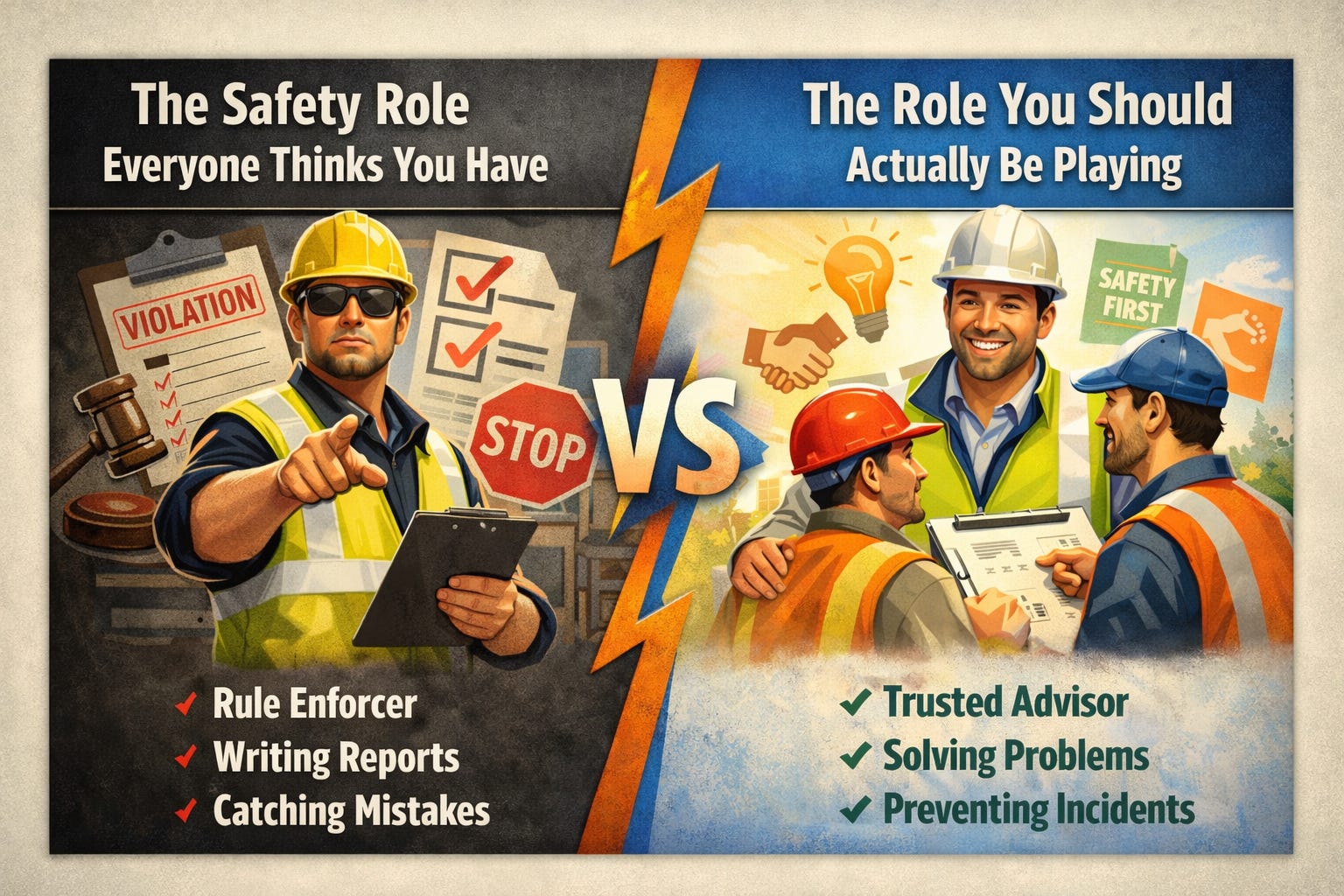
It’s a situation most of us have faced at one time or another. The Ops manager expects you to be the rule enforcer, that your primary function in safety is to catch people doing something wrong. In their mind, your job is to be on the shop floor all day pointing out everyone’s mistakes.
You’re expected to be the “Safety Cop’, responsible for policing workers, enforcing rules, and correcting unsafe behaviors. This is, of course, incorrect, and worse, it damages workplace safety culture in insidious ways.
Now, of course, as a safety professional, if you see a worker doing something that could lead to an incident, you should absolutely call it out. But this should be the exception rather than the rule.
The truth is, the Occupational Health and Safety Act clearly states that front line supervisors are the party responsible for enforcing safety and providing a safe working environment for their employees.
And there’s a very good reason for that.
Let’s look at a couple of scenarios to illustrate this point:
Example 1
You walk the shop floor on your daily rounds. You see a worker without eye protection and remind them. They put their glasses back on. Seems simple enough, but there’s a subtle psychology at play when this happens.
The worker learns: “I need glasses when the safety guy is around.”
The supervisor learns: “Safety handles PPE.”
Everyone involved comes think of the Safety Department as an external policing mechanism, rather than a coaching and hazard prevention resource. However, when the supervisor stops the job and says, “We don’t start work like this. Get your glasses.” The worker learns, “This is how our crew works, this is the expectation for how I do my job.” Doing it right becomes the expectation, not a separate rule to be discarded whenever you can get away with it.
Example 2
As the safety pro doing a hazard assessment, you find a machine guard removed. You escalate. You document. You remind.
The worker’s perception becomes: “This safety department rule is slowing me down.”
The supervisor’s view is: “Safety is being difficult again.”
But when the supervisor says, “Put the guard back. We don’t bypass equipment on my shift.” Now it’s no longer a safety rule, it’s a production rule.
Do you see the difference in culture?
The Unintended Culture Shift
When the safety professional enforces rules as their regular job over the long term, you unintentionally create a host of undesirable circumstances:
Supervisors who abdicate responsibility. Preventing risk to workers becomes the safety department’s problem.
Workers who perform safety for appearances. The safety manager isn’t on the shop floor all the time like the supervisor, so it becomes a game of avoiding getting caught.
A culture where safety is separate from operations, rather than part of the way things are done.
Unrealistic expectations for senior management, supervisors and workers. Everyone has their own expectations of what safety should be and how it should be run. But without training or knowledge of the legislation, those expectations are misinformed. The regulations make it clear that supervisors are the ones charged with enforcing safe behaviour in the workplace.
Constant frustration for the safety professional. You’re caught between management and workers and not really trusted or accepted by either. You know what needs to be done, but convincing others is a perpetual pain point.
The Role You Should Actually Be Playing: Advisor and Influencer
Instead, I recommend a different approach.
The safety professional’s role is to serve as an advisor and influencer.
Someone who has the training and experience to spot risk in the workplace and advise solutions. Someone who can be seen as a neutral party between workers and management. A coach who can guide workers and management without being beholden to either one.
As an advisor, you become someone who can help leaders and workers avoid incidents, avoid paperwork, and avoid more serious consequences. You become someone they call for advice before there’s a problem. Workers begin to speak up about potential hazards instead of hiding them. Management starts to see you as a strategic partner rather than simply an administrator.
What This Looks Like in Practice
With a more positive culture shift, the safety professional shifts into a role the regulators initially envisioned.
The true role of the safety manager is to:
Coach supervisors instead of correcting workers. Instead of, “Don’t do this, it’s against the rules,” the message is, “Here’s why this is risky and here’s how to do it safely.”
Help management understand risk and liability. You advise leadership on the hazards in the workplace and become part of the solution.
Ask questions instead of issuing directives. Understanding the why is the first step in fixing the problem. When you lead with a directive, you miss an opportunity for deeper understanding.
Participate in planning rather than reacting to incidents. So many safety professionals are stuck simply reacting to incidents after the fact. Instead, as a trusted advisor, you plan ways to prevent accidents before they happen.
That’s it for this week. I hope I’ve given you some ideas to consider and begin to execute in your workplace.
Let me know in the comments how you’ve implemented some of these ideas in your business.
Cheers,
Dan.