

Hello and Welcome to this week’s edition of Safety Pro Weekly.
I’ve seen it many times before.
A new safety professional walks into an organization and their first instinct is to change everything, preferably back to the way things were done at their previous employer.
“Back at ABC company we used to do this …” is how they start every conversation.
New policies, new procedures, new checklists, a (not so subtle) tweak to the management system …
And all this happens long before they’ve taken the time to truly understand what the company is already doing and why.
Their goals and expectations are lofty and well intentioned. Problem is, in the rush to prove their worth, these new leaders leave everyone else behind.
Before long everyone around them is confused, exhausted and no safer than before.
Why this Matters
The first 90 days are absolutely crucial for a new safety leader.
This is where they set the tone for long-term effectiveness. Within 90 days, they either build momentum or completely lose credibility and flame out.
And frankly, this is where many flame out.
The critical thing to understand as a new safety leader is that influence, not enforcement, is what drives real change.
By walking into a new situation, guns blazing, ready to show the world what they’re made of, they quickly alienate established employees who are used to doing things a different way.
Change can be beneficial, but it’s crucial that you manage the pace of change, especially in a new setting.
The Mistakes
There are 3 key mistakes that new safety professionals often make in a new setting are:
Trying to “fix everything” too quickly. The vibe they give off is, “Everything is wrong, this company is in deep trouble.”
Over-reliance on policies, procedures, and enforcement. Many safety pros can quote chapter and verse of even the most obscure regulations, but fail to understand the work being done or the pressures, stakeholders and culture of the business.
Focusing on systems before understanding people. Your job is to keep people safe, and to do that, you need to understand why they do what they do. Production pressures, shift changes, and personal issues (to name a few) all impact people’s behaviour. Get to know your fellow employees as people and your job becomes so much easier.
Why It Happens
We all come into a new job wanting to do well. As safety professionals, we care and we know the importance of doing things right. So why do so many make these mistakes? It’s a combination of factors:
Pressure to prove value quickly. It’s quite normal to want to prove your worth, and you will. Just be careful of the pace at which you try to change things.
Misunderstanding of the safety role. Many safety professionals still feel that their role is to be an enforcer of rules, when they should be influencing behaviour. Enforcing rules is the supervisor’s responsibility. You are there to coach and advise.
Lack of a clear onboarding strategy for safety leaders. There is so much to learn when you start a new role, the first months are always a huge challenge. Without a clear plan for how to proceed, it’s easy to get lost in the day to day and lose your effectiveness.
What Great Safety Leaders Actually Do
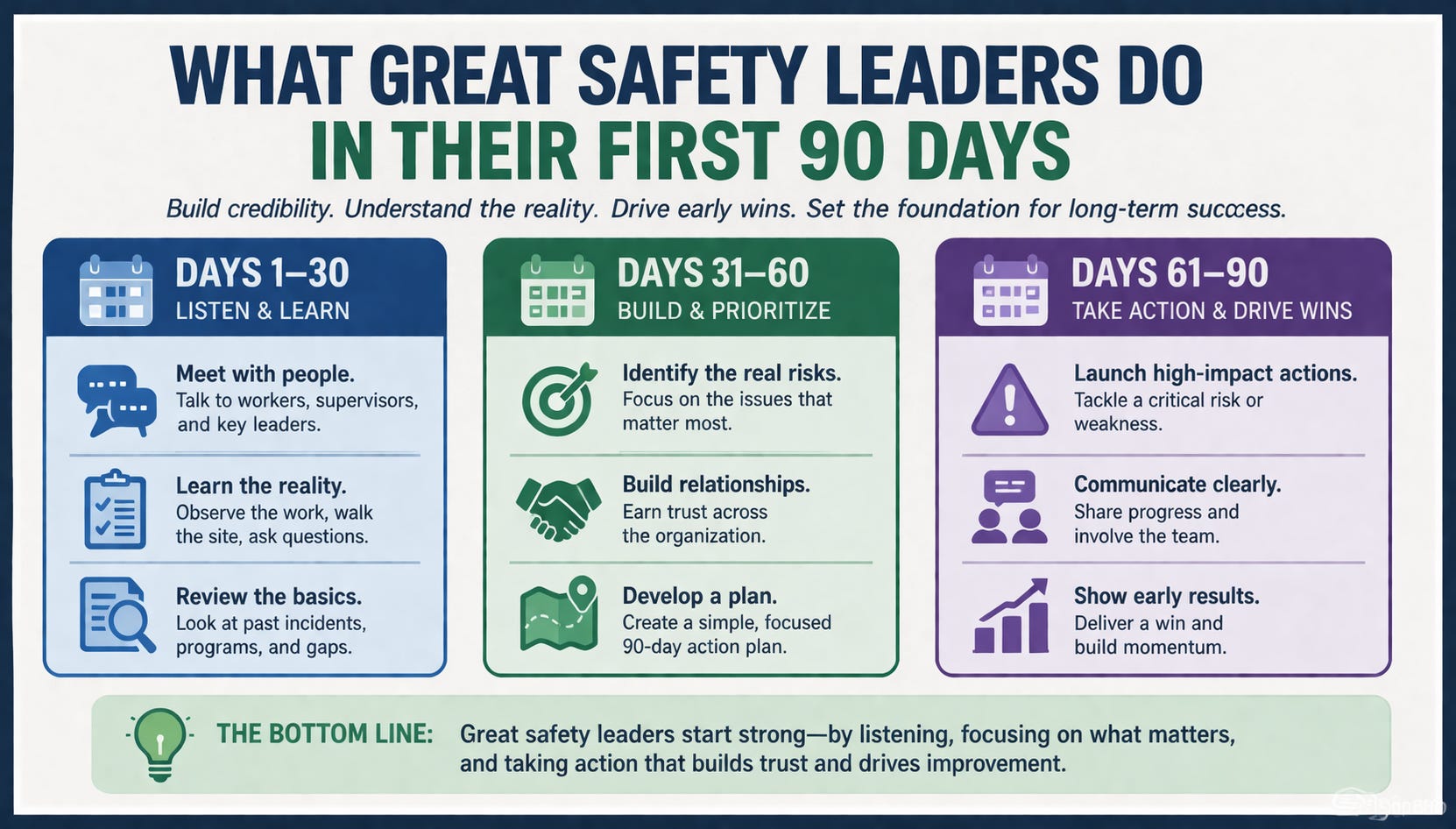
Here’s a realistic plan to get you through the first 90 days.
1. Listen Before You Act
Spend time with workers, supervisors, and managers. Ask: “What makes your job harder or riskier than it needs to be?”
Build trust before introducing change. The greater trust you establish, the easier it will be to create the change you want to make.
2. Identify the Real Influencers
The best leaders in a company don’t always show up on the org chart. For example, a machine operator with 20 years of experience who knows the equipment inside out, trains new hires informally and who employees tend to go to before their supervisor often has more influence on worker behaviour than the company President.
Informal leaders shape behaviour more than policies.
These individuals are key. Build relationships with them early and they can be a tremendous resource.
3. Focus on One Visible Win Early On, then Build on It.
Select one quick, meaningful improvement (not paperwork) that you can make in the workplace. For example, fix one recurring hazard or simplify a process or report form. Establishing one big win early on allows you to build credibility and momentum for future changes.
4. Activate Supervisors Early
Front line supervisors are the most important people in any business. Establish those relationships early and make sure you are on the same page in terms of expectations. Provide simple tools (checklists, conversation prompts) or help them simplify a process. Remember, supervisors are constantly pressed for time. Make their life easier in some small way and you’ll build an important ally.
5. Observe Work as It Actually Happens
Go to the floor, job sites, real environments. Compare “work as imagined” vs “work as done.” Often there’s a big difference. Look to identify system gaps, not just worker behaviour. You can’t make a job safe until you know how it’s (actually) being done.
6. Avoid the Compliance Trap
Don’t start with policies and audits. Everybody hates those, and they rarely change behaviour. Use compliance as a foundation, not the strategy. Instead, focus on behaviour, decisions, and leadership actions. This is where you’ll get the biggest bang for your buck in terms of accident prevention.
7. Communicate Early and Often
Share what you’re seeing and learning with workers and management. You’ll need both on your side if you are to succeed. Reinforce that safety is a shared responsibility and everyone’s contribution is important. Position yourself as a partner, not a police officer.
The more you build trust and communication, the more likely people will share with you how the work is really being done and what the real challenges are.
The Takeaway
This week, schedule 3–5 conversations with frontline workers or supervisors. Ask one question: “What’s the hardest part of doing this job safely?”
Use this info to create a small win you can share with workers and management alike. Each small win builds your credibility, trust and influence within the organization. Actions like these build the foundation you need to accomplish what you want to do in your organization.
That’s it for this week.
I’d love to hear what steps you’re taking to succeed in your workplace. Let me know in the comments.
Cheers,
Dan.


