

Hello and welcome to this week’s edition of Safety Pro Weekly.
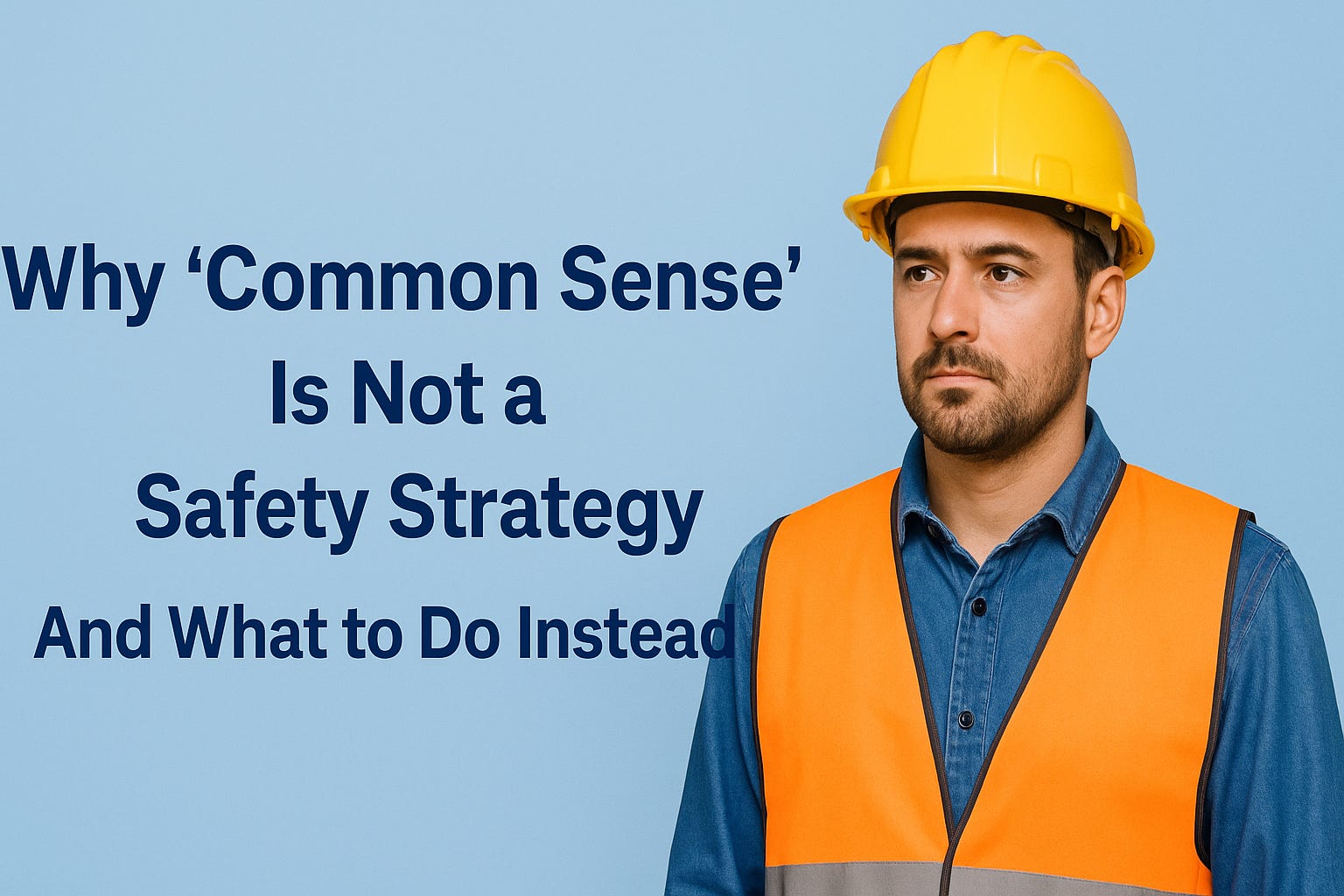
In my 14 years as a safety professional, I can’t tell you how many times I’ve heard the phrase, “Safety is just a matter of common sense.”
Usually this comes from a seasoned worker or manager trying to understand why a seemingly preventable incident has just occurred. “If only the worker had just used their common sense, it would never have happened.”
It’s understandable. It sounds reasonable. It quietly shifts responsibility onto the workers.
And it’s wrong.
In this is issue:
Why common sense is highly dependent on past experience and training.
Why relying on common sense makes your communication less clear.
4 steps you can take to fix it.
The reason I challenge this notion of ‘common sense’ is that common sense is entirely dependent on prior knowledge. Knowledge a worker may or may not have.
What might be obvious to a worker with 20 years of experience is definitely not obvious to a rookie in his first week.
For example:
An experienced forklift operator can feel when a slightly raised load on a turn becomes unstable, even before it tips. A new operator hasn’t yet developed the muscle memory to sense when things are about to go astray. When a supervisor tells them to ‘just use common sense’, the rookie hears ‘drive slowly and be careful’ and misses the important cue of ‘keep the load low and slow down when turning.’
The instruction becomes general rather than specific because common sense means different things to different people.
Relying on common sense assumes that everyone sees risk the same way. Worse, it offers no guidance in unfamiliar or high-risk situations. “Use your common sense” doesn’t mean much if you’ve never encountered a situation like this before.
In safety, assuming common sense often means assuming knowledge that was never taught.
Common Sense is not a Strategy
Common sense is not a strategy, a control, or a substitute for instruction, yet this type of thinking is common in many workplaces.
If your workplace is one of them you might hear phrases like:
“Everyone knows not to put their hand there.”
“It should be obvious this is dangerous.”
“They should have known better.”
The implication is that the worker should have anticipated the risk and done something differently.
But this is not about intelligence. It’s about exposure, experience, and context. The very tools that new and young workers lack.
What many label ‘common sense’ might be better called ‘proper training and hands on experience’.
Why This Happens
Training gaps get papered over. When training is rushed or informal, “common sense” fills the gap. This creates uneven risk for workers with less background or exposure.
Hindsight bias after incidents. Once something goes wrong, the hazard feels obvious. What can be difficult to keep in mind is that before the incident, it often was not.
It’s a comforting shortcut. Blaming an incident on a lack of common sense often avoids harder conversations about task design, supervision, procedures, and production pressure.
What to Do Instead
Replace “Common Sense” with Clarity. Clearly define expectations and explain why hazards exist.
Design Out Guesswork. Use physical controls, signage, visual cues, and standardized procedures. If people have to guess, the system has already failed.
Teach How to Think About Risk. Train hazard recognition using real scenarios, not just rules and theory.
Model Better Language. Replace “Use common sense” with:
“Here’s what to watch for.”
“Here’s why this task is risky.”
“Here’s how we expect this to be done safely.”
Strong safety systems do not rely on what people should know. They support people in the risks they actually face at work.
When leaders stop saying “common sense” and start building clarity, incidents decrease and trust increases.
If your safety system depends on common sense, it is not a system.
It is a gamble.
That’s it for this week.
I would like to personally wish all of you the best this holiday season! Safety Pro Weekly has recently passed 400 subscribers and 1100+ followers on LinkedIn and I want to personally thank each one of you for giving me 5 minutes of your time each week to talk about safety.
By the way, I also ghostwrite for other professionals, founders and thought leaders on LinkedIn and Substack. If you’re interested in building your authority and reach to help you attract more opportunity but don’t know where to start, feel free to message me for a free consultation to see how I can help.
Cheers,
Dan.


I agree! People throw that term around like somehow we are born with this knowledge, but what isn’t taught isn’t common. How lucky are those who are in-the-know to have had good role models to teach them those skills?