

Hello and welcome to this week’s edition of Safety Pro Weekly.
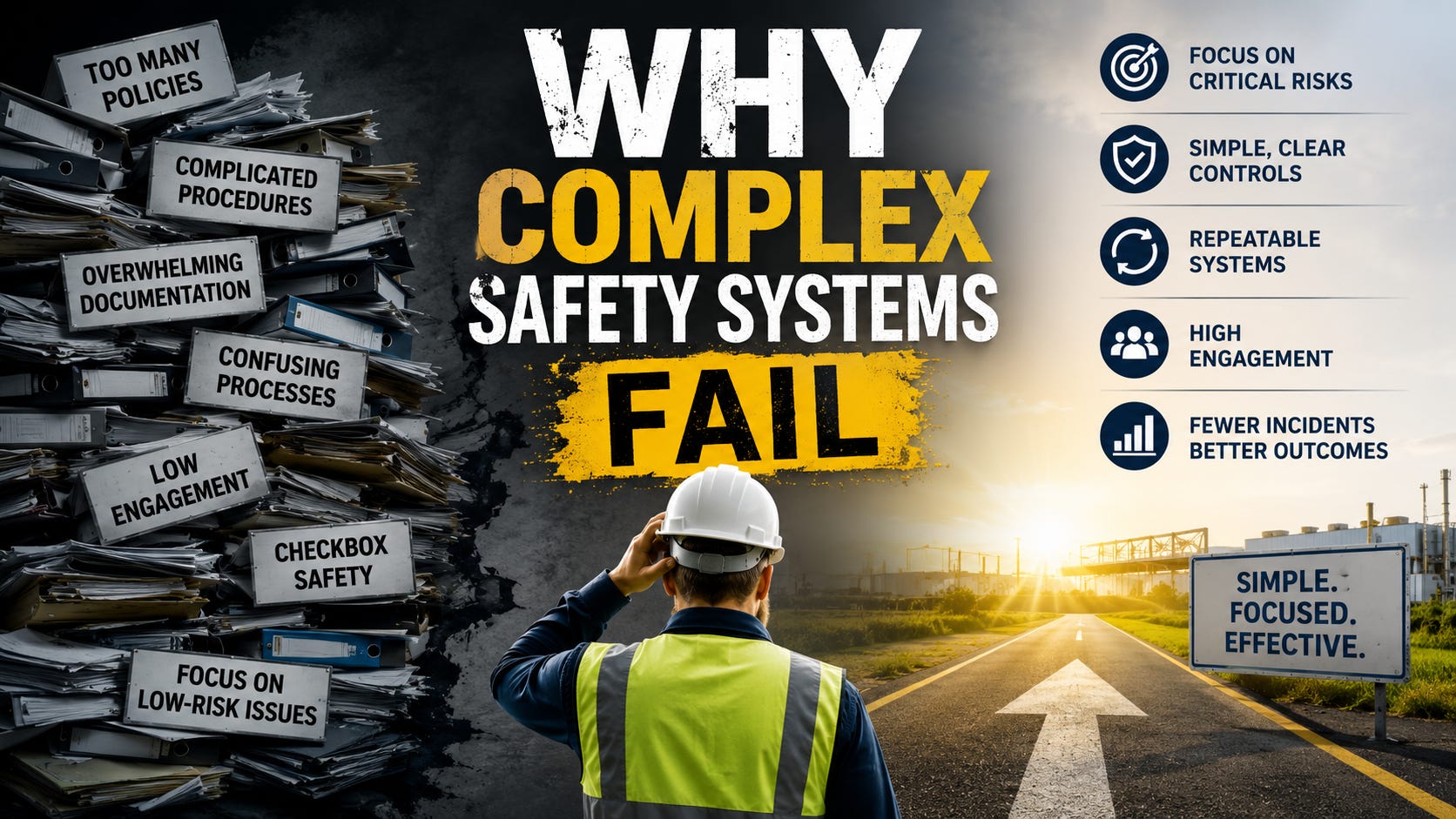
This week I want to talk about complexity in safety systems and how to much of it sets you up to fail. The key concept here is that the strongest safety programs are not the most complicated. They are the clearest, simplest, and most repeatable.
Safety programs do not fail because people don’t care about safety.
They fail because the system becomes too complicated to consistently understand, support, communicate, and apply in the real world.
When your safety program becomes a massive, overarching system that tries to control every process and action, you create 3 significant problems:
Workers disengage because they can’t keep track of all the things they’re supposed to do.
Management doesn’t buy in because it’s too complex, and most importantly,
Safety departments get burnt out from trying to manage everything and may miss something important.
The Safety Leadership Blueprint is a practical, no-fluff course designed to help safety professionals move beyond compliance and start influencing real change.
Built around 7 core pillars including engagement, leadership, and systems that actually stick, it shows you how to connect safety to business priorities, gain buy-in from leadership, and build a program that works in the real world, not just on paper.
To join the waitlist, comment Blueprint.
The Complexity Trap
Safety professionals often fall into the trap of believing that adding more automatically improves safety. More checklists, more procedures, more rules.
The intention is good, but the assumption behind it is flawed.
When you run into problems with your safety program, it’s tempting to add more checklists, more procedures, more policies, more meetings. And sometimes, this is necessary. But every layer of complexity adds friction to the system.
Eventually the program becomes so administratively heavy that people disengage from it entirely.
This happens because workers and supervisors already operate under constant pressure:
Competing priorities
Production demands
Staffing shortages
Operational problems
Customer expectations
Fatigue
When safety systems become too difficult to navigate, people naturally simplify them on their own. They stop reading procedures. They rush through inspections. They attend meetings mentally checked out.
Not because they are careless, but because the level of complexity becomes unmanageable.
People Won’t Follow What They Don’t Understand
One of the biggest problems with overly complex safety systems is that they often make sense to the safety department, but not to the people expected to use them.
Frontline supervisors are constantly under pressure and do not have time to interpret:
lengthy procedural manuals
overlapping systems
unclear expectations
complicated approval processes
excessive documentation requirements
Workers need clarity above all else. They must understand:
What matters most
What the critical hazards are
What controls are non-negotiable
What good performance looks like
Leadership needs to relate safety to the bottom line so they can:
Effectively allocate limited resources.
See a clear cause and effect between investment and outcome.
Align programs with organizational reputation.
Foresee and prevent risks to the business.
If the system is confusing, inconsistent, or overloaded with low-priority requirements, people stop treating it as meaningful.
Complexity Is Hard to Sell to Leadership
The reality safety professionals often overlook is that complexity is difficult to sell to senior management. Senior management’s technical background is not in Health and Safety, it’s in operational management, so to get them to buy in, you have to communicate accordingly.
Leaders need to understand:
the major risks to the company.
the operational impact.
the return on investment.
what actually prevents incidents.
When safety programs become overly technical or bloated with excessive initiatives, leadership often disengages because the system feels disconnected from operational reality. This is especially true in small and mid-sized businesses.
Most incidents come from predictable risks
One of the biggest mistakes organizations make is trying to build systems that address every imaginable hazard equally.
As in, “What happens if a herd of elephants comes charging through the shop floor and we don’t have an SOP for that???”
I’m joking, but the point is, not all risks deserve equal attention.
In most workplaces, a relatively small number of hazards account for the majority of serious incidents.
Things like:
mobile equipment interactions
falls
machine guarding failures
lockout failures
manual material handling
vehicle incidents
struck-by hazards
These are the risks most likely to seriously injure people.
Yet many organizations spend enormous time and energy managing low-probability administrative risks while critical operational hazards receive inconsistent attention.
Instead, your main focus should be on:
The hazards most likely to seriously harm people
The hazards most likely to occur
The controls most capable of preventing those incidents
This creates clarity in your safety program for everyone involved.
Workers understand what matters most.
Supervisors know what to reinforce.
Leadership understands where resources should go.
Repeatable Systems Beat Complicated Systems
The best safety systems are not the most comprehensive. They are the most repeatable.
A simple process consistently followed will almost always outperform a sophisticated process inconsistently applied.
For example:
A short daily equipment inspection consistently completed properly is better than a complex audit nobody finishes.
A five-minute meaningful toolbox talk is better than a 45-minute presentation employees tune out from.
A few clearly enforced critical rules are often more effective than dozens of inconsistently applied procedures.
Repeatability creates habits, which build culture over time and drives long term safety performance.
The Goal Is Not Minimalism, It’s Clarity
This does not mean organizations should eliminate procedures, documentation, or formal systems.
Complex operations sometimes require complex controls.
But complexity should only exist where it genuinely adds value.
The goal is not to create the largest safety program, the goal is to create a system people can realistically understand, support, and consistently apply under real working conditions.
The organizations with the strongest safety performance are often not the ones with the thickest binders.
They are the ones that:
identify the highest risks
focus on critical controls
communicate clearly
reinforce consistently
keep systems practical and repeatable
Apply This Tomorrow
Ask yourself one simple question:
“What would happen if we simplified our safety program tomorrow? Would safety performance decline, or would people finally engage with it more consistently?”
Then identify and simplify:
one unnecessary layer of bureaucracy
one overcomplicated process
one low-value administrative task
In safety leadership, clarity and consistency often prevent more incidents than complexity ever will.
Cheers,
Dan.


