

Hello and welcome to this week’s edition of Safety Pro Weekly.
I’ve seen variations on this theme many times before:
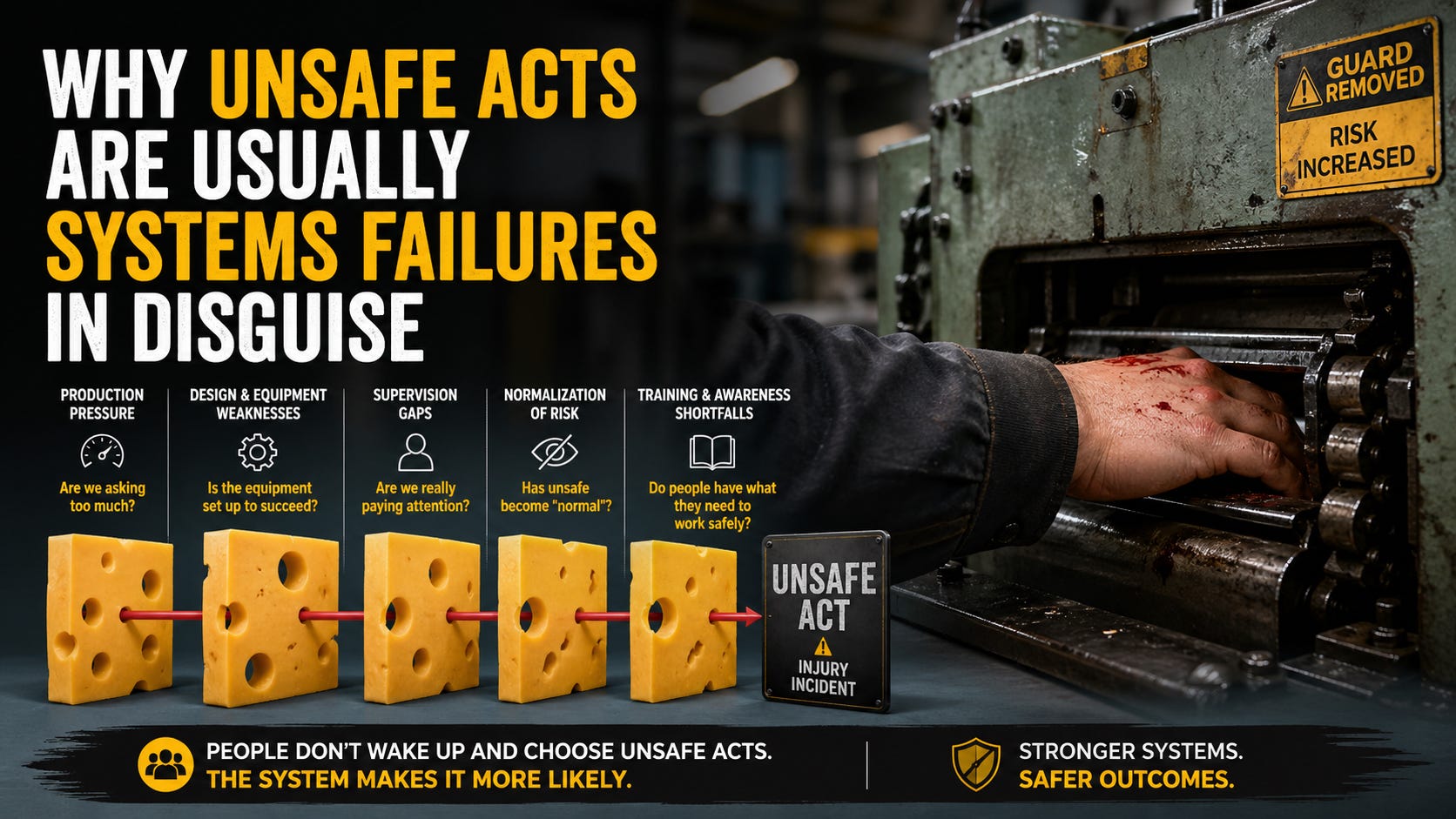
A worker is under pressure to increase production. The machine he’s using has a guard that is slightly bent, causing material to jam up as it feeds in, slowing the process.
On the night shift, where supervision tends to be lighter, someone decides the guard is more trouble than it’s worth and tosses it aside to keep things going.
The next morning a dayshift worker starts up the machine, unaware the guard is missing. During the operation, his hand is caught in the unprotected moving parts.
The typical reaction on an accident investigation leads to this being classified as an unsafe act: the removal of a guard and the operation of a machine without checking to ensure the guard was in place.
And it is – on the surface.
But we need to go deeper if we are to prevent a similar incident from happening in the future.
While this was clearly a serious mistake on the part of the worker involved, the fact is, he had reasons for doing so. Wrong reasons, but reasons that made sense to him in the moment.
What could have made this decision make sense to the worker?
For example:
Production pressure?
Frustration with frequent jam ups?
Not wanting to bother the mechanic to fix the guard?
Not wanting to irritate his supervisor?
Having reported hazards in the past and being ignored?
When we look deeper, we find that what many investigators write off as Unsafe Acts are, in fact, systems or process failures in disguise.
The Mistake
Most often the correct action in cases like these focuses on blame, retraining, or discipline rather than system improvement.
But this misses the deeper point.
Treating incidents as behaviour problems instead of process problems ignores valuable information that can make your workplace safer. Rather than writing it off as worker error, you need to get to the question of why the worker made the decision.
Why It Happens
There are a number of reasons why less experienced incident investigators might stop at worker error and call it a day. Here are a few:
It’s faster and easier to blame individuals. If it’s the worker’s fault, disciplining him should fix it. Right? Problem is, disciplining one worker won’t stop the same thing from happening to someone else.
The “Common sense” mindset. If Joe had just used his “common sense” it would’ve solved the problem. The thing is, Joe has never been trained in hazard assessment and therefore underestimated the risk.
Pressure to close investigations quickly. Everyone’s busy. Worker error seems like a quick and easy solution. Mark it down and case closed. Except there’s nothing to stop it from happening again.
Lack of visibility into how work is actually performed. If safety professionals and supervisors don’t have a good understanding of how the work is actually performed (especially when no one is around) it’s easy to miss clues like the fact that the guard had been bent for months and nobody bothered to fix or report it.
Instead of asking, “Why did they do that?” You need to look at what part of the system that allowed or encouraged this behaviour?
The Process Lens (Where to Look)
The answers aren’t always obvious, but here are some places you can look:
A. Workflow design. Complexity, sequencing and time pressure all raise the likelihood of errors.
B. Environment. Check the layout, clutter and access issues around the workspace. In many cases, these are just accidents waiting to happen.
C. Tools & equipment. Are the tools and equipment workers are expected to use ergonomic? Is regular maintenance performed? Are there easy workarounds for safety devices?
D. Signals & communication. Are workers clear on expectations? Are they reasonable? When there are conflicting priorities, how does the worker decide what’s most important?
E. Culture. IS there constant production pressure? Are workers reluctant to speak up? Are hazards and near misses routinely brushed under the rug?
What This Changes
When you start to think in terms of systems failures rather than just worker error, things start to change:
Better investigations. You start getting to the true root cause which means better corrective actions.
System-level fixes instead of temporary solutions. This leads to a reduced number of repeat incidents and fewer incidents over time.
Increased worker engagement and trust. This can’t be overstated. When you stop looking to blame the worker, you get better buy-in, better communication and a better overall safety culture.
How to Apply It
When you find yourself reaching a verdict of “worker error” in your investigation, use this 3-question filter:
1. What made this action possible?
2. What made it likely?
3. What made it acceptable?
When you have the answer to these questions, you’ll have the appropriate corrective actions to prevent this from happening again.
When you fix behaviour, you get temporary compliance. When you fix the process, you get lasting improvement.
That’s it for this week. Thanks for tuning in.
A quick personal note:
After 14 years as a safety professional, I can say that one of the hardest things is that you often have to do it alone. Few companies choose to hire multiple people for the Safety Department and the burden of not only having all the work, but also not having anyone to share the responsibilities and burdens of being a safety pro often leads to stress, isolation and early burnout.
I want to change that.
I’m building a community of safety professionals called the Safety Leadership Blueprint. The first 15 founding members who join the wait list will get full access to my Safety Leadership Blueprint course, as well as a weekly coaching call and specific discussion forums where you can introduce yourself, ask questions and get answers from myself and your peers in the group.
Launch is coming soon at a reduced price for founding members.
If you’re interested, write “Safety” in the comments or DM me for more information.
Cheers,
Dan.


You make so many good points here! This is exactly why I wrote my book Uncorporate Leadership. We need better leaders if we want to improve safety. Your words give great insight into the how. Thank you for sharing!